|
London museums |
Courtauld Gallery |
 |
|
 |
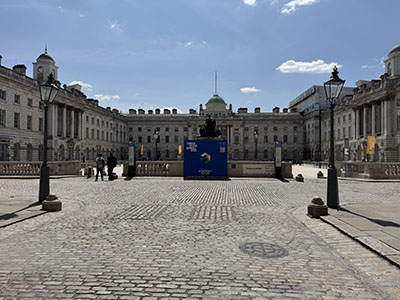
| The Courtauld Gallery and Courtauld Institute (a prestigious art school) are located in Somerset House, a public building constructed on the site of a Tudor-era palace in 1776 and expanded later on. It has more than a hundred art-oriented tenants. |
|
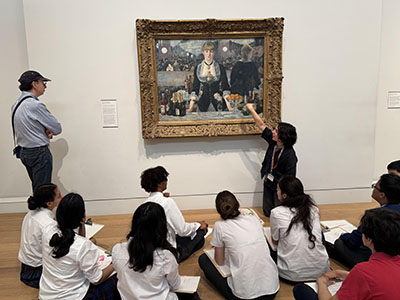
A Bar at the Folies-Bergère by Édouard Manet, 1881, depicts a barmaid in that Paris nightclub standing before a mirror talking to a gentleman who is outside the painter's field of vision. Manet associated oranges with prostitution in his paintings, so he implies the barmaid was a salesperson and commodity—something to be purchased along with a drink. |
 |
|
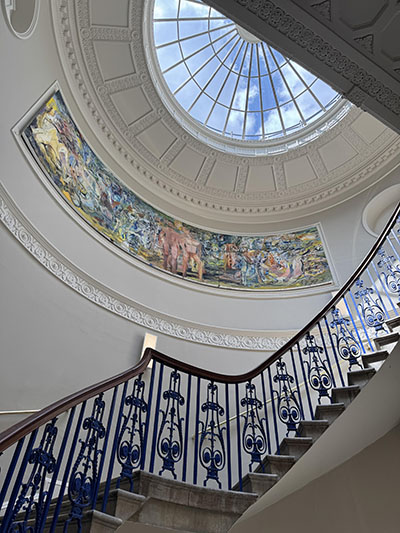 |
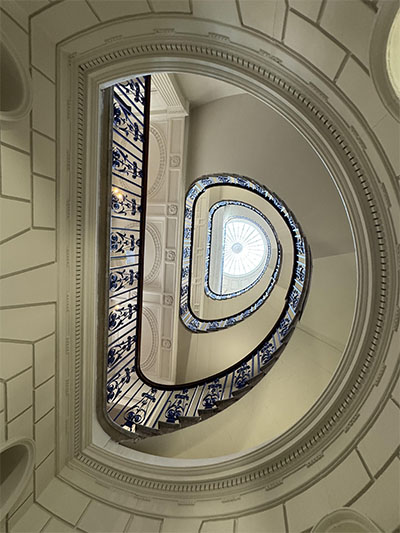
| Staircase views in the Courtauld Gallery. |
 |
|
 |
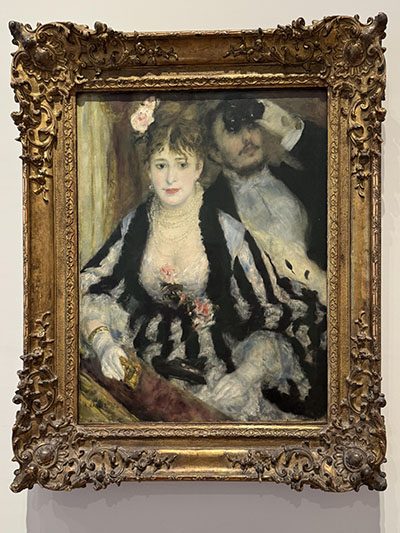
| La Loge (The Theatre Box) by Pierre-Auguste Renoir, 1874, depicts a young couple in a Paris theatre. Going to the theatre in 19th century France was as much about being seen as watching the performance. While the woman is making her presence obvious, her companion is scanning the audience through his opera glasses. |
|
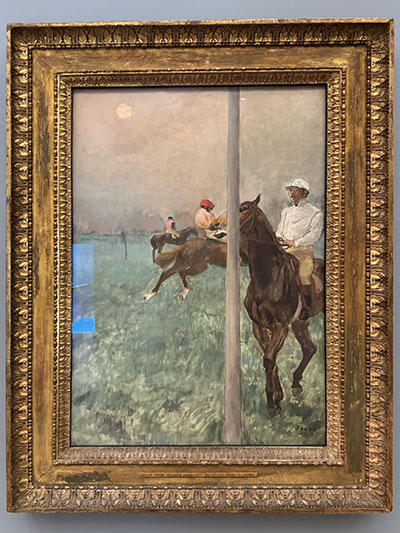
Jockeys Before The Race by Edgar Degas, 1879, was inspired by Eadweard Muybridge’s attempts to capture motion in still images, Degas used stop-action photographs to capture movement in his horse racing scenes. |
 |
|
 |
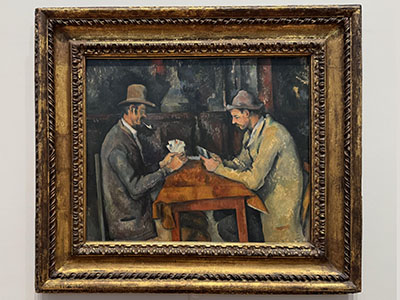
| The Card Players by Paul Cézanne, 1890, was one of five paintings of laborers playing cards. |
|
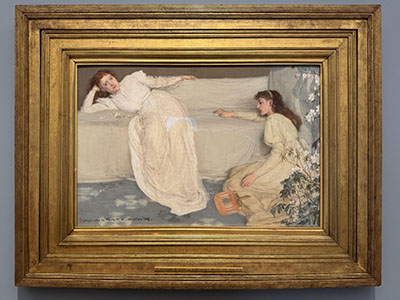
Symphony in White, No. III by James McNeill Whistler, 1867. The model on the sofa is the artist's mistress. (Definitely not his mother!) |
National Gallery |
 |
|
 |
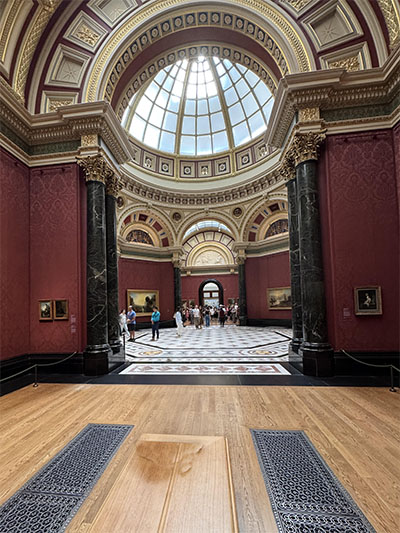
| Magnificent! Room 36, one of eight Barry Rooms designed by architect Edward Middleton Barry and decorated by
John Crace & Sons, the most important interior decorating firm in England through the 19th century. |
|
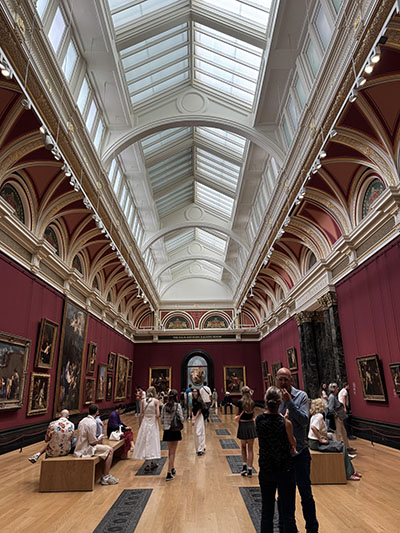
Stunning! Room 32, the largest Barry Room, is named the Julia and Hans Rausing Room. (He is heir to the Tetra Pak
food packing company. His first wife was an American who he met in a rehab clinc in the US. Her death sparked huge publicity because she had lain dead in the couple’s bedroom for months.) |
 |
|
 |
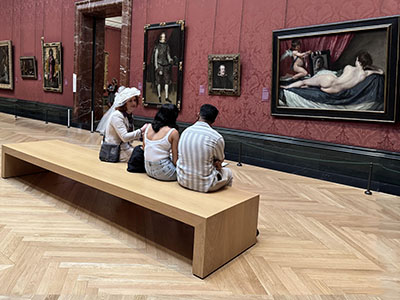
| The white-hatted lady seemed to have stepped out of a canvas. |
|
Intriguing! Three Men and a Boy, probably by the French Le Nain Brothers before 1648—the year Louis and Antoine died. Their deaths may explain why the painting is unfinished. (The picture reveals part of an earlier composition—the head of a boy on the right and blue and yellow drapery.) |
 |
|
 |
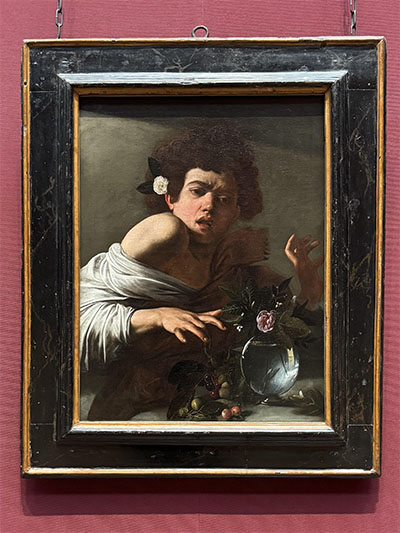
| Boy Bitten by a Lizard by Caravaggi, probably painted in Rome in the 1590s. It was very unusual then for a painting to show such a moment of action, but Caravaggio rejected artistic convention and painted directly onto the canvas from live models. This gave his works an immediacy and intensity that made them instantly popular. |
|
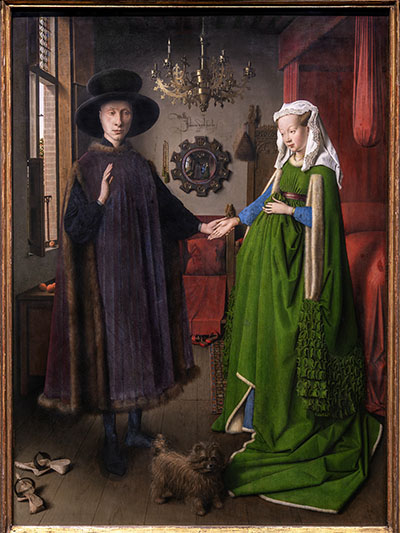
The Arnolfini Portrait by Jan van Eyck, 1434, shows a richly-dressed couple in a private room with objects chosen to proclaim their wealth and social status without risking criticism for aping the aristocracy. The man’s hand is raised in greeting. On the back wall, a large convex mirror reflects two men entering the room, one of whom also raises his hand. |
| |
|
next |
| created by webstarlines.com |